Skip to content
Interview mode · New

“Can you go a bit deeper on that?”

Skip the script.
Speak like an insider.

Press Help me answer and the answer comes in point by point: your experience, an insider's words. No templates, no lines everyone has heard.

Your computerWorks on Mac and Windows. The shortcuts below follow your pick.
Interviewer
And if a consumer crashes mid-batch, how do you still get exactly-once?
You press⌃⌥Space Help me answer
CueBee · Answer cardDone
Follow-up: if a consumer crashes mid-batch, how do you still get exactly-once?Approach Draw the line first: Kafka gives exactly-once only inside Kafka; the database side relies on idempotent writes, with the offset committed in the same transaction.
  1. Draw the line on exactly-once“Strictly, Kafka only gives you exactly-once inside Kafka: read, process and write back in one transaction.”
  2. Idempotent writes on the database side“Our sink was Postgres, so we made the write idempotent: an upsert keyed on the event ID, with the offset committed in the same transaction.”
  3. The cost, then the result“It cost one extra index lookup per event, and after that the nightly reconciliation stopped finding duplicates.”
Start talking at the first pointYour material, the field's standardSample question and sample background
Why we built Interview modeA few thoughts on interviews todayRead itClose

Where we stand

Work has run on AI for a while.
Interviews still test what you memorized.

Once you're hired, nobody asks you to code from memory. You read the docs, ask AI, dig up old notes. That's what work looks like. Then the interview rolls the rules back ten years: write out from memory a problem AI solves in seconds, and tell a story you prepared, word for word, nervous and in a second language.

What that measures is who memorized more and whose first language happens to be English, not who gets things done.

Knowing how to work with AI is one of the most important skills at work today. If the test is behind, that doesn't mean you are. CueBee doesn't invent your experience: the stories are yours and so is the judgment. It helps you tell the whole, true story in the few minutes when nerves hit hardest.

Real workLook it up; asking AI is normalThink it through in your best languageJudged on results: did it get doneTime to think
Interviews todayNo looking up; all from memoryPut it together on the spot, in your second languageJudged on the moment: did you memorize itSeconds to start talking

Using AI against an outdated test is nothing to feel guilty about.

Insider answers aren't luck

Not just a model with a prompt.
Every answer card is tuned to the field's standard.

We don't let the AI freewheel. Behind every answer card is a way of writing tuned by field: first work out how this field works today, then decide how to answer; wherever it doesn't sound like an insider, test it on real jobs and fix it.

  1. 01Research done for you, before you say a wordIt reads you first: your résumé, the job post and the details it asks you for. Then it looks into the company and the field: what happened this past year, how it's done today, what people are arguing about.
  2. 02Your story, told to the standard that makes an expert sit upLike a senior colleague who has done this kind of work, it asks for the details your résumé left out, finds the strongest angle and fills the story out. Anything it adds is marked, and nothing goes in until you confirm it.
  3. 03Every time you speak, the field as it is nowTechnology and trends come from what your prep pack found and what it looks up on the spot, with dates, not from the model's old memory. What you say is where the field is today.
  4. 04Blind-tested on real jobs, rule by ruleBlind tests on real public job posts: every card that sounded recited, every line that didn't land, every term dropped with nothing behind it became a rule written into every answer card.

BeforeThe homework, done for you.

Step 1 · Before

Drop in your resume and the job post.
The homework is done.

It asks a few questions your resume doesn't answer, researches the company and the field at the same time, and writes your whole prep pack.

A video interview on a laptop, with a resume clipped beside itA video interview on a laptop, with a resume clipped beside it
  1. 01Resume + job postPDF, image or screenshot
  2. 02It checks, then asksUp to 6 questions, all skippable
  3. 03Company and field, researchedA year of news, the field today
  4. 04Your prep pack, writtenFilled-in details marked
It researches the company
  • What the team behind this role builds, from the company's own pages
  • A year of news: launches, funding, layoffs, leadership, results
  • How the company interviews, and what it hires for
And where the field is nowNew
  • Today's mainstream practice, and what it replaced
  • What the field is debating
  • What interviewers in this field listen for
  • A few recent things worth mentioning, each with its date

Any field: engineering, finance, consulting, healthcare… It first works out what “current” means there, then goes to first-hand sources.

Answers that speak to the field today

Moving billing reconciliation to streamingStory 2 of 6 · for technical depth, trade-offs, launch risk

Situation
Billing reconciliation ran six hours a night and often missed the month-end close.
Task
Move it to streaming before month end, without getting a single account wrong.
Action
Partitioned Kafka by account and made writes idempotent on the event ID; ran old and new in parallel for two weeks, diffing every account.Filled in by CueBee
Result
Reconciliation went from six hours to about twenty minutes, with zero differences at switchover.

How to say it: “We ran the old batch job in parallel for two weeks and diffed every account before we switched over.”

Check what it filled in before you use it
6
questions at mosteach one skippable
4–8
storiesfilled-in details marked
12
likely questionsat most
2
self-introductions30 s · 90 s
60+
languages understoodinterview in any of them

In the interview, every answer card reads this prep pack first.

Step 2 · The night before

Before the real one,
rehearse with an AI interviewer.

Once the prep pack is ready, so is a mock interview: an AI plays this company's interviewer, asks out loud and follows up on your answers. By the real thing, you've answered these once already.

Maya · Engineering manager, billing platformPlayed by AI · generated for this company and rolePracticing · 12:40
Walk me through how your streaming reconciliation handles events that arrive late.
We keep a two-day window per account, and anything later goes to a correction job instead of rewriting closed totals.
And what happens if a correction lands after finance has already closed the month?
Stuck?Tap, and CueBee gives you a hint
Leave the nerves in practice
The interviewer is generated for this company and role, not a template
It asks out loud and you answer out loud, like the real thing
It follows up on what you said
Afterwards, a summary: the full transcript and where you asked for help

DuringYou do the talking. CueBee's right beside you.

Step 3 · Opening

Think in your language.
Speak in theirs.

English, Japanese, German… any interview language works. What to say is written in the interview's language, with a translation in yours.

Which language is the interview in? Pick one

These are the eight in the menu; if the job post is in another language, CueBee writes in that one too. Speech recognition understands over 60 languages.

CueBee · Answer cardInterview in Japanese
前職ぜんしょくで一番いちばん難むずかしかった判断はんだんは何なんですか?What was the hardest call you made at your last job?
  1. Lead with the decision結論けつろんから言いうと、新機能しんきのうの公開こうかいを二週間にしゅうかん延期えんきする判断はんだんです。The hardest one was delaying a new feature's launch by two weeks.
  2. The reason and the trade-off決済けっさいの二重計上にじゅうけいじょうが再現さいげんできていたので、売上うりあげより信頼しんらいを優先ゆうせんしました。We could reproduce a double-charging bug, so I put customer trust ahead of the quarter's revenue.
Japanese comes with kana readings
The question comes translated, so you know what was asked
What to say is in the interview's language, with your translation underneath
Change the interview language, and the parts of your prep pack you'll say are rewritten
Step 4 · First question

You press.
It writes.

No press, no answer; one press, and it writes. When the interviewer finishes, press once (a shortcut on the computer, or a tap on the phone) and the answer comes in point by point. Start talking at the first one.

Point by pointStart talking at the first one
Read aheadA press goes straight to writing
One press does itThe question, its type, the answer
Press again any timeA new question? The newer press wins
Not just answersIt doesn't only answer questions.
It helps you freestyle.

An interview isn't a quiz. When you finish and nobody picks it up, or you want to say a little more, press Help me answer again without waiting for a new question: it looks at what you just said, carries it further and gives you something to keep talking about. You just keep going.

Nobody asked, and you still have something to say

You just finished a project…so in the end, reconciliation went from six hours a night to about twenty minutes.

The interviewer says nothing…You press Help me answer

CueBee · Keep going

  1. The impact“That let finance close the month two days earlier, because they stopped waiting on our job.”
  2. What you learned“The lesson: run old and new side by side and diff every account before you switch. It's slower, but it's the only migration I'd trust.”
  3. Back to this role“It's also why this role caught my eye: your team is moving the ledger to streaming too.”
Sample question and sample background
Step 5 · Stumped

Others recite templates.
You talk like an insider.

One question, two answers: one anyone could give, one only someone in the field could. CueBee answers from inside the field, with the decisions, trade-offs and numbers you've actually dealt with.

A closed loop is the floor.
The insider's layer is what sets you apart.

Plenty of AI answers feel great to say: logical, well-structured, convincing to you. To the interviewer, they're the basic version every candidate gives. CueBee doesn't aim for smooth. It has the model think the question through and go further, then answer like a senior person in the field, so you can talk with ease about the latest technology, what's changing right now and what insiders are seeing.

Sample question

“After we moved to Kubernetes, our p99 latency doubled but p50 didn't move. Where would you look?”

A typical AI answer

“I'd take a holistic approach: monitor the key metrics, check the logs, optimize the code, and leverage autoscaling to make the system more robust and scalable. Then I'd close the loop with the team.”

Anyone could say this
CueBee · Answer card
  1. Flat p50, doubled p99: suspect something intermittent“If p50 is flat and only p99 moved, the code isn't slower. Something intermittent is: queuing, GC, or throttling.”
  2. The usual suspect on Kubernetes: CPU limits“On Kubernetes my first suspect is CPU limits. CFS quota pauses the container for the rest of each period, and that lands exactly in the tail.”
  3. Prove it with data, then fix it“I'd plot container_cpu_cfs_throttled_periods_total against p99. If they line up, raise the limit or drop it and keep the request.”
  4. Your experience, from the prep pack“I've seen this pattern on a JVM service: the GC threads burned through a one-CPU quota, and the tail went with them.”
Narrow it down, then bring evidenceThis is how people in the field debug it
Your prep pack firstYour stories, your fit, the company
Company and field, researchedA year of news, the field today
New tech, looked upSearched while writing; notes follow
Every point says somethingDecisions, numbers, trade-offs, what went wrong
The field's own wordsp99 and CFS throttling, not “synergy” and “leverage”
Consistent, and like youYour numbers stay the same; the wording sounds like you
Step 6 · Something new

New term? Looked up on the spot.
Latest news? Ready to say.

Answers don't rely only on what the model remembers. When the interviewer brings up new tech or a recent shift, CueBee searches the web for the latest.

CueBee · Answer card
If we let AI agents call our internal APIs, how would you scope what they can do?
  1. One gateway, no keys handed to agents“I'd put the internal APIs behind one MCP server, so agents go through a single gateway instead of each holding its own keys.”
  2. Permissions follow the person“Every call carries the end user's OAuth token, so an agent can never do more than the person who asked it to.”
Note · just looked upSource: modelcontextprotocol.ioMCP (Model Context Protocol): an open protocol Anthropic released in November 2024 that gives AI apps one standard way to connect to tools and data; authorization for remote servers builds on OAuth 2.1.You could add: “The MCP spec builds remote authorization on OAuth 2.1, so we wouldn't have to invent our own.”
What you say is the field today
Before: the company and the field today, researched
During: anything unfamiliar or recently changed is searched while writing
Notes come with their dates and sources
Plus a line you could bring up yourself
Step 7 · Coding

Code in parts.
Math step by step.

Press ⇧⌘9 to capture the question. Every part of the code comes with what to say, every derivation is laid out, and multiple choice gets the answer and the reason.

Derivation · expectation

Each cereal box has one of n toys, equally likely. How many boxes, on average, until you have all n?

Once you have k kinds, the boxes until a new one, Tk, are geometric: each box is new with probability (n − k)/n.

E[Tk] = nn − kE[T] = Σk=0n−1 nn − k = n·Hn≈ n ln n (about 225 boxes for n = 50)

What to say: “Each new toy is a geometric wait, so I add up n over n minus k, which is n times the harmonic number.”

Coding · ⇧⌘9 Capture

Find the median of a stream of numbers as they arrive.

 1 class MedianFinder:
 2     def __init__(self):
 3         self.lo, self.hi = [], []  # max-heap, min-heap
 4     def add(self, x):
 5         heappush(self.lo, -x)
 6         heappush(self.hi, -heappop(self.lo))
 7         if len(self.hi) > len(self.lo):
 8             heappush(self.lo, -heappop(self.hi))
 9     def median(self):
10         if len(self.lo) > len(self.hi):
11             return -self.lo[0]
12         return (-self.lo[0] + self.hi[0]) / 2

Add O(log n) Median O(1)

What to say: “The low half lives in a max-heap and the high half in a min-heap, so the median is always on top.”

Multiple choice · distributed systems

A Raft cluster has 5 nodes. How many can fail while it still accepts writes?

  1. A 1
  2. B 2 ✓
  3. C 3
  4. D 4

Why Writes need a majority, so 3 of the 5 must be up. Lose 2 and the remaining 3 can still elect a leader and commit; lose 3 and they can't.

  • Behavioral · motivation → lines you can say out loud
  • System design · case → key points, main idea first
  • AI allowed → the plan to talk through, plus instructions to paste into the agent
  • Code won't pass → capture again for the lines to change
  • Stuck mid-sentence → it picks up from your half sentence
  • Out of things to say → it takes the topic further
Step 8 · Screen sharing

Share your screen.
The answers are on your phone.

The computer listens and captures; you read the answers on your iPhone. We support a floating window too, but it can't be trusted on a Mac. Why we recommend the phone, and how it joins, all below.

Also supported · computer onlyThe floating window: answers above every window
  • Hide from screen sharing is on by default
  • Windows 10 (version 2004) and later: excluded by the system, so people in the call won't see it
  • Mac: hidden from most sharing and recording, but we don't promise it
Why it can't be trusted on a Mac
  1. Since macOS 15, meeting apps and browsers that share through Apple's ScreenCaptureKit can ignore a window's “don't capture me” setting, so the floating window may be shared too.
  2. Apple gives apps no public way to hide from screen capture, so we don't promise the floating window.
  3. A full-screen meeting app can cover the floating window, and the system asks for permissions now and then.
  4. Once you press ⌃⌥H to hide CueBee, there's nothing left to read on the computer.
Recommended · computer + phoneThe answers on another device
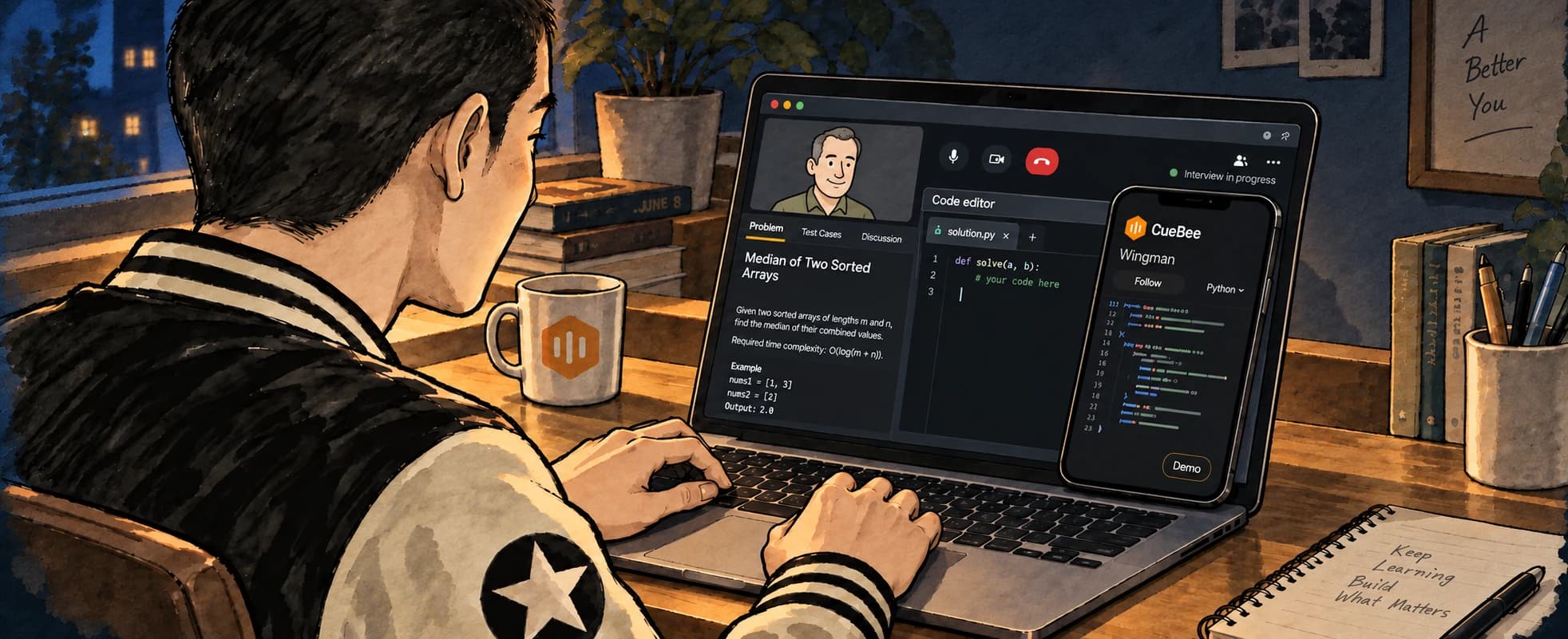
At night, Tomato takes an online coding interview at the computer, with the phone propped against the screen showing CueBeeAt night, Tomato takes an online coding interview at the computer, with the phone propped against the screen showing CueBeeThe answer's on the phone
What the camera seesCameraPhoneKeyboardYou
From the side: the laptop camera faces you, and the phone at the bottom edge of the screen stays out of its frame.
  • Only the computer's screen is shared; the phone was never in the picture
  • Stand the phone against the bottom of the screen; the camera faces you and usually can't see it
  • The computer can stay hidden the whole time, with the answers on the phone
  • Help me answer, Capture and Rewrite from the phone; the computer follows

How the phone joins

  1. 1One account on bothInstall CueBee on the iPhone and sign in to the same account as the computer. No QR code, nothing to pair in advance.
  2. 2Start the interview on the computerWithin 30 seconds a notice appears on the phone's Home. Tap Join.
  3. 3Stand the phone below the screenCaptions and answer cards show on the phone; Help me answer, Capture and Rewrite work from it.
  4. 4Before sharing, press ⌃⌥HCueBee disappears from the computer and keeps listening; the phone shows “Hidden” at the top.

iPhone and iPad can join; Android can't yet.

One key hides it. It keeps listening.

No CueBee in any window, in the Dock or the app switcher; recording, transcription and shortcuts carry on.

⌃⌥H
Hide / press again to come back
⌃⌥Space
Help me answer · works while hidden
⇧⌘9
Capture · grab the question on screen
Step 9 · Stuck or silent

Stuck mid-sentence? Picked up.
Silence after? Carried on.

Press Help me answer again: stuck halfway, it continues from your last word; out of things to say, it checks what you said, then takes the topic further. Pick a scene.

Interviewer · video interview · last question

What are you looking for in your next role?

You said…and that's why I'm looking for a role where I can

Without Interview mode“…where I can… where I can… um, grow?”Stuck on one word, and the whole answer fell flat.
With Interview mode⌃⌥Space Help me answer
What are you looking for in your next role?Keep going You stopped at “a role where I can”. Finish that sentence, then go back to your prepared answer.
Finishing your sentence“…own a system end to end, from the design review to the on-call rotation.”
After this line, back to your prepared answerInterview mode · Mac / Windows
Stuck halfway, and you still finish the thought.

Demo · sample questions and a sample background. Interview mode doesn't read aloud; answers show only on the screen and the phone.

AfterEvery interview makes the next one better.

Step 10 · Afterwards

What went well, what didn't:
AI reviews it with you.

A summary is ready the moment it ends, and every answer card and the full transcript stay in your history. Ask CueBee which answer was weakest and how to do better.

Backend engineering intern · round 25 questions · transcript and answer cards saved

Summary · written when it endsThe interviewer pushed twice on consistency and wasn't satisfied with the rate-limiter answer. You promised to send Lisa in HR your portfolio link by Wednesday, plus a short write-up of the rate-limiter design.
  1. 1Tell me about yourself1:24
  2. 2The hardest system you've built2:51
  3. 3Exactly-once when a consumer crashes2:10
  4. 4Design a multi-instance rate limiter2:46
  5. 5Any questions for us?0:58

Which answer was weakest, and how do I fix it?

Question 4. You explained the token bucket, but not where the count lives across instances or what happens if Redis goes down. Next time, lead with consistency and fallback: atomic decrements in Redis, and a per-instance local limit when Redis is unavailable.

Sample

Stop memorizing templates.
Take CueBee to your next one.

Free accounts can use it. For the week of your interview, an Interview Pass adds more: one payment, no renewal.

In the interview: Mac · Windows | iPhone: prep pack and second screen | Android: not yet

Writes only when you press. Never joins the meeting. Follow the interviewer's rules; what you say is still your own words. Once this month's premium answers are used, a lighter model writes the cards.

About screen sharing on a Mac: according to Electron's documentation (BrowserWindow.setContentProtection), since macOS 15, recording and sharing through ScreenCaptureKit ignore a window's content protection, so some ways of sharing can still show the floating window. Windows 10 (version 2004) and later has a system setting that keeps a window out of screenshots.

You might also be wondering

Is using AI in an interview cheating?

We don't think so. Your work already runs on AI, yet interviews still test memorization and puzzles AI solves in seconds, which says little about what a person can really do. CueBee works from your own experience and judgment; it just keeps an outdated format from holding you back. We hope interviews change soon. Until they do, companies' rules differ, so check before you use it.

Does CueBee join my Zoom call?

No. It never joins as a participant; it only listens to the sound on your own device. Where recording needs consent, ask first.

Is it free?

Sign up and get 3 hours of translation plus 3 hours of Wingman, no card needed. Interview mode comes with 20 free premium answers a month; after that it keeps answering on a lighter model. With Read translation aloud on, translation time counts double.